Structural reliability of a property-line pile–cap system: paper presented at the XII Colombian National Congress on Earthquake Engineering (June 2026)
DIADICA funded the research presented in June 2026 at the XII Colombian National Congress on Earthquake Engineering on an optimized property-line pile–cap system, evaluated with performance-based design, OpenSeesPy and 10,000 Monte Carlo simulations.
DIADICA Proyectos e Ingeniería funded a research paper that was accepted and presented in June 2026 at the XII Congreso Nacional de Ingeniería Sísmica (Colombian National Congress on Earthquake Engineering). The full paper (proceedings, pp. 252–260) can be downloaded from the research page.
The work was led by the founding partner and project manager, Oscar Darío Moreno Borja, and applies performance-based design and Monte Carlo simulation to the safety assessment of deep foundations.
Scope of the research
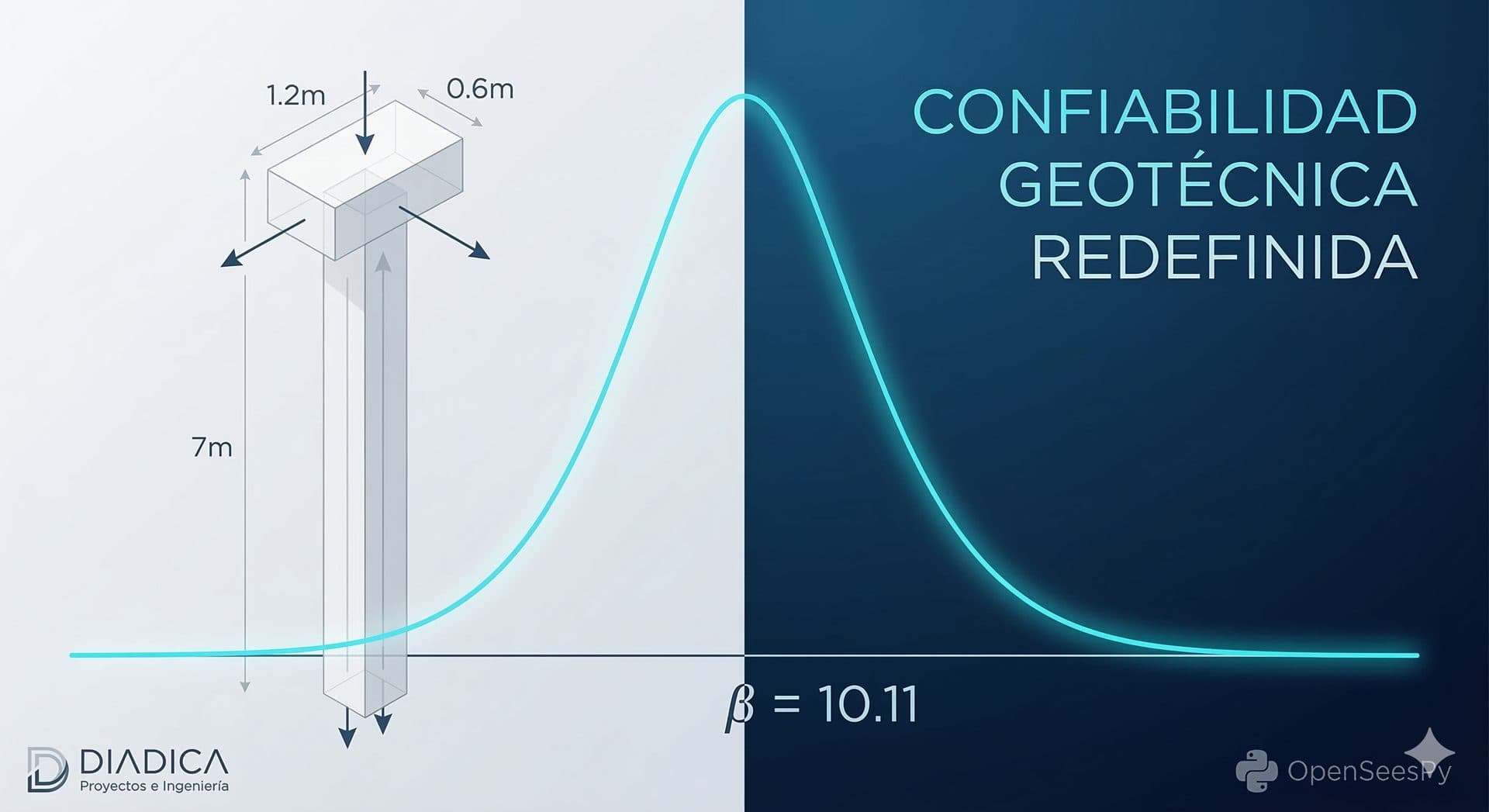
The study deals with a property-line pile–cap foundation, the usual solution when a column sits against the lot boundary and the foundation cannot be centred under the load. The optimized system evaluated has a 0.60 × 1.20 × 1.50 m cap on a pile with diameter D = 1.0 m and length L = 7.0 m, under a 1500 kN load.
Conventional design of these systems is deterministic and relies on conservative safety factors, which often leads to larger and more expensive foundations. In this work, besides checking the safety factor, the performance of the system under service conditions was evaluated with a soil–structure interaction model that estimates its displacements.
Quantifying uncertainty
The variability of the soil properties was treated explicitly. Using the open-source platform OpenSeesPy, 10,000 stochastic Monte Carlo simulations were run to measure how that variability affects the safety of the system.
The mean displacement at the column head was 45.28 mm, against a 75 mm limit, and the second-moment reliability index was β = 4.44, which under a normal response corresponds to Pf = Φ(−β) ≈ 4.5 × 10⁻⁶. Counting the runs directly, 17 of 10,000 exceed 75 mm, so Pf ≈ 1.7 × 10⁻³ (β ≈ 2.9): the lognormal soil stiffness skews the response and the tail is heavier than the normal fit. The analysis covered the 1500 kN load with a 100 kN lateral load at the column head; seismic and wind demands on the structure were outside the scope of the paper.
Use in DIADICA's projects
With this kind of study the firm brings into its projects the methods currently discussed in earthquake engineering. When the performance and reliability of the system are quantified, foundations can be sized with less over-design and without reducing safety, which shows up in the project cost. Each solution is also fitted to the expected behaviour of the soil and the structure on site.
Outlook
The scientific committee of the XII Congreso Nacional de Ingeniería Sísmica reviewed and accepted the paper, and it was presented at the event in June 2026. The result shows that structural reliability is a practical tool for designing more rational and economical foundations with a known level of safety.
DIADICA will keep developing this line of research and applying it to the projects the firm designs in Colombia.