
DIADICA Academy
Technical training in structures, geotechnics and modelling
Courses in structural design, geotechnics, building codes and computational modelling. Models are built in CYPE, checked with Python routines and interpreted with NSR-10.
Video · 53 s
DIADICA Academy in one minute
Three class exercises solved in Python and checked against theory: a seismic wave rising through a soil layer whose amplification matches the closed-form solution, the principal stresses and Mohr circles obtained from a stress tensor, and the flexural strength of a beam computed with the Whitney block and with a fibre section. Then the DIADICA Academy training lines.
Method
Modelling and verification
Content. Model set-up, assumptions, reading of the response and an independent check calculation. Models are built in professional software and their results are checked against Python routines and the mechanics of the problem.
Course material. Mechanics of the stress tensor and principal stresses, and dynamic problems such as wave propagation through a soil layer. In each exercise the numerical logic of the model is reviewed, the physical response is interpreted and the result is compared with an independent calculation.

Seismic wave propagation in a soil column
Finite-difference model of an elastic soil column. The script produces the seismograms, showing the amplification of the wave toward the surface, and a heat map of the wave travelling through the layer.
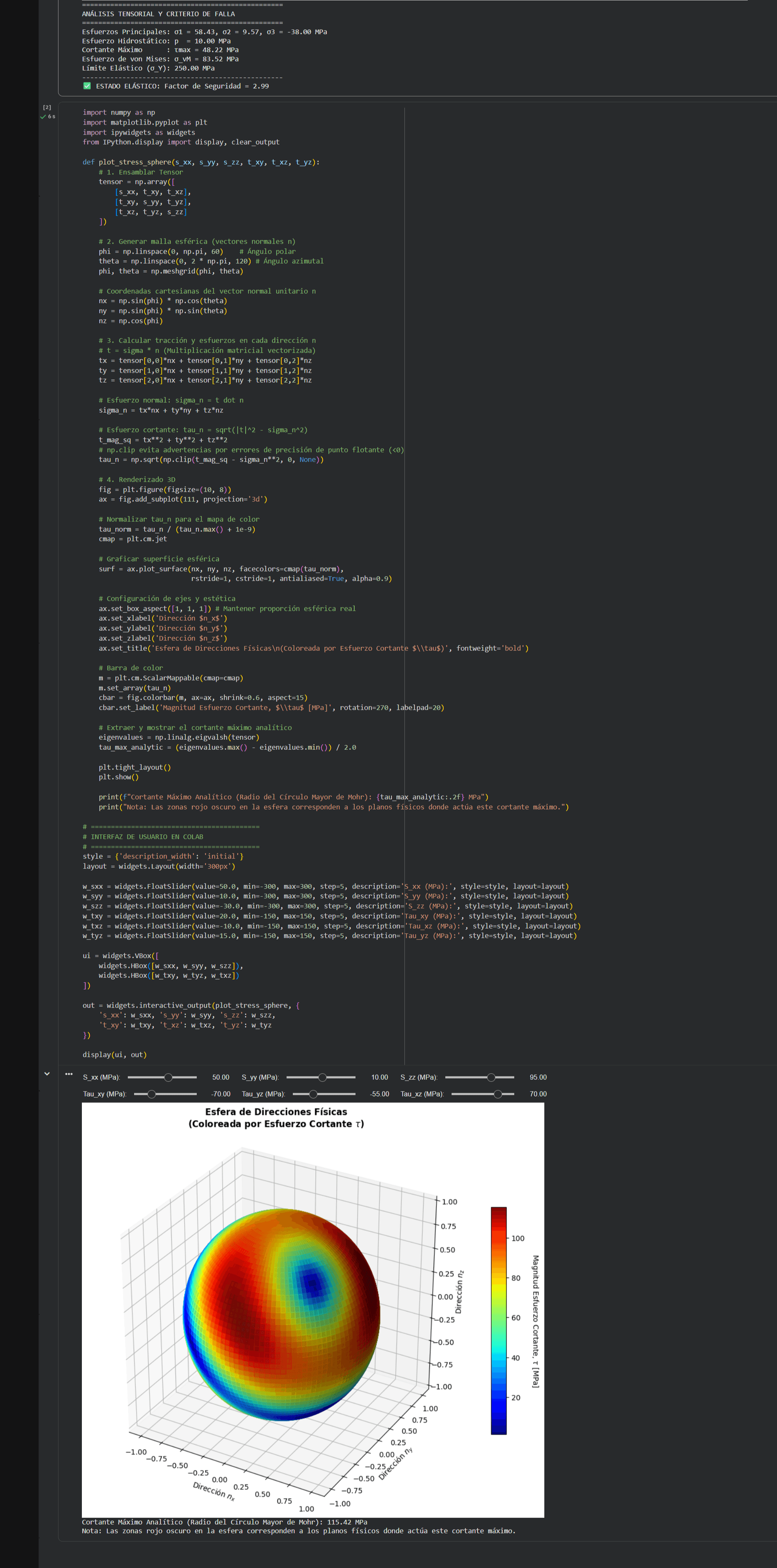
Stress state in three dimensions
Sphere of directions coloured by shear stress, used to locate in 3D the principal directions at a point and the planes of maximum shear.
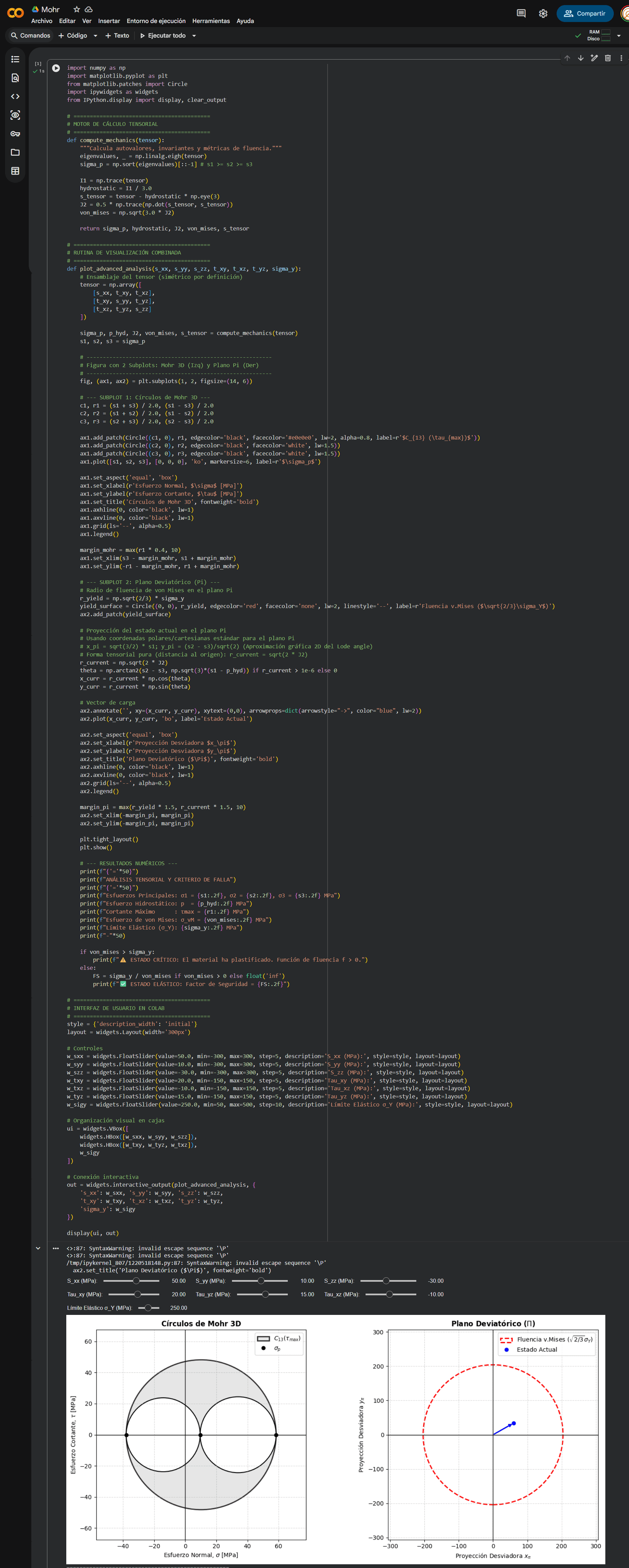
Mohr circles and deviatoric plane
The three Mohr circles and the deviatoric plane of the same stress state, with the yield criterion drawn over them. The same reading applies to structures and to geotechnics.
Training lines
Program catalogue
Structural design, geotechnics, codes and permits, and modelling and verification.
Structural design
Structural masonry under NSR-10 with CYPE and Python
Reinforced, partially reinforced and confined masonry under chapters D.7, D.8 and D.10, from the unit data sheet to the reinforcement of each wall, with a Python verification engine that checks the CYPE results.
Concrete beam and slab design
Flexural and shear design of reinforced concrete beams and slabs under Title C of the NSR-10, with each result checked by an independent calculation.
Post-tensioned concrete buildings
Post-tensioned slabs and beams: tendon layout, losses, service and strength limit states, and review of the program results.
Steel structure design under NSR-10
Members in tension, compression, flexure and combined forces, and their connections, under Title F of the NSR-10 and the AISC 360 specification.
Steel buildings with BIM
Seven modules: members and floor systems, seismic force-resisting systems, buildings, AISC 358 prequalified connections, foundations and BIM workflow with IFC. Python is the calculation engine, and CYPE and RFEM are checked against it.
Geotechnics
Diploma in applied geotechnics
Soil mechanics, site investigation, shallow and deep foundations and slope stability under Title H of the NSR-10.
Geotechnical interpretation and foundation design
Reading soil studies and applying them to the design of shallow and deep foundations.
Codes and permits
Titles J and K of the NSR-10
Fire protection and means of egress with the amendments of Decrees 092 of 2011 and 340 of 2012: classification, occupant load, exits, stairs and fire resistance, with the review of a complete permit file.
Structural and geotechnical permitting before Colombian curadurías
Technical and legal criteria of the building permit process under the NSR-10: filing, frequent observations and responses to review reports.
Modelling and verification
Soil-structure interaction with CYPE and Python
Interaction between the structure and the ground under chapter A.7 of the NSR-10, with CYPE as the modelling environment and a Python application the participant builds module by module.
Data science and artificial intelligence in structural and geotechnical engineering
Forty-eight hours of data methods and machine learning applied to structural and geotechnical cases. Each module is taught once its case has been implemented and validated.
Featured program
Soil-structure interaction with CYPE and Python
The course studies how ground flexibility changes the period, the damping and the design forces of the structure. CYPE is used as the professional modelling environment, and the participant builds, module by module, a Python application to review and check the model results.
- Foundation stiffness and equivalent springs
- Site effects with the Medellín seismic microzonation
- Period and damping of the coupled system per NIST GCR 12-917-21
- Checking the CYPE results against the Python application
Participants
Participant profile
Engineers who design with computational models and need to verify them.
- Practicing structural engineers
- Geotechnical engineers
- Graduate students in structures
- Structural design professionals
- CYPE users who want to check their results with their own calculations
- Professionals who want to verify with Python
Background
Experience of the firm
Formats
Training formats
Live technical courses
Synchronous sessions with instructor and practical cases
Cohort programs
Closed groups with follow-up and feedback
Workshops and seminars
Intensive sessions on specific topics
Diplomas
Longer programs organized in modules
Specialized modules
Thematic units for in-depth study
Enrollment
Program information
Dates, syllabi, fees and enrollment requirements are provided through the contact channel.