Seismic Uncertainty in RC Frames with Unreinforced Masonry: Bayesian Updating with Puebla 2017 Data
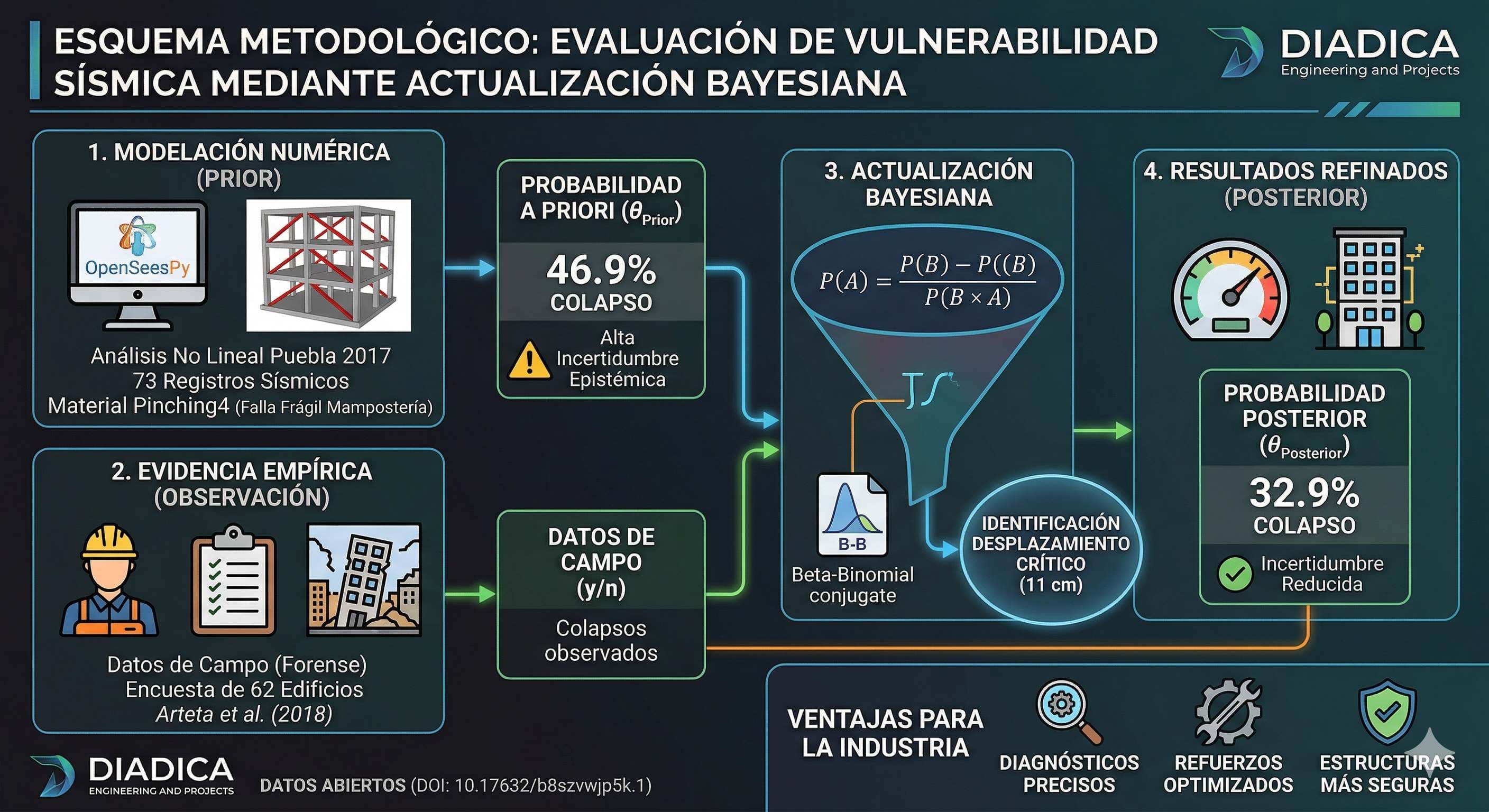
DIADICA Synthetic Core applied Bayesian inference to update the collapse probability of concrete buildings with unreinforced masonry walls: from 46.9% in the theoretical model to 32.9% once field evidence was included.
By: Eng. Oscar Darío Moreno Borja, MSc (c), founding partner and project manager of DIADICA Proyectos e Ingeniería S.A.S.
The 2017 Puebla earthquake in Mexico produced valuable information on the behavior of reinforced concrete buildings that use unreinforced masonry walls (brick or block) as partitions.
In design practice these walls are usually handled in one of two opposite ways: they are ignored altogether, as if they added neither mass nor stiffness, or they are assumed to protect the building. Forensic evidence from that earthquake shows that both assumptions can lead to unsafe results.
That was the question taken up by DIADICA Synthetic Core: how can the collapse probability of these systems be estimated with fewer assumptions and with real data?
The epistemic uncertainty problem
How a brick wall degrades during an earthquake depends on properties that are not known exactly; this lack of knowledge is what is called epistemic uncertainty. When a typical 5-story building was subjected to 73 seismic records from the 2017 event, the theoretical model gave a collapse probability of 46.9%. The open question was how much of that figure reflected actual behavior and how much came from the limitations of the numerical model.
Bayesian updating
To compare the model with what was observed, Bayesian inference was used. The theoretical probability of 46.9% was taken as the prior and updated with forensic data from 62 mid-rise buildings that survived or collapsed in the same earthquake. The walls were modelled with the Pinching4 material in OpenSeesPy, and the collapse probability of the model was updated with the conjugate Beta-Binomial pair.
Results
Brittle masonry failure appeared at 11 cm of lateral displacement at roof level. Beyond that point the wall stops carrying load and suddenly transfers shear to the concrete columns, which in the cases analyzed led to the collapse of entire floors. With Bayesian updating, the collapse probability went from the theoretical 46.9% to 32.9%, a value supported by field evidence.
Use in projects
Once the work has completed its external review, these results could be used in the assessment of existing buildings. A risk estimate updated with real data avoids overstating vulnerability and, with it, more costly interventions than needed. Knowing the deformation level at which the walls fail allows the retrofit to be designed for that threshold, intervening only the elements that require it.
Open science
The structural models, programming code, and seismic records from this research are publicly available and can be audited under DOI: 10.17632/b8szvwjp5k.1.
The manuscript with the complete study is in preparation and has not yet been submitted to a journal.
This work is part of the research line of DIADICA Synthetic Core, which complements code application with its own studies of how structures actually behave and how they protect the lives of their occupants.