XIX Congreso Colombiano de Geotecnia
Site Response of Mudflow Deposits over Saprolite of the Antioquia Batholith
Nonlinear site response of a mudflow deposit over saprolite of the Antioquia Batholith, classified as site class E by SPT, studied with 480 three-dimensional finite element analyses on a stochastic population of profiles and compared with the amplification that NSR-10 assigns. The same campaign trains five AI surrogates that place the physics of the wave equation in different parts of the model.
Video · 53 s
The paper in one minute
Two thousand profiles generated with the distributions of the paper, the linear response of the deposit, the amplification peaks by intensity level, the comparison with the NSR-10 class E spectrum and the five AI surrogates, with the figures and tables of the paper.
Research Overview
Over the Antioquia Batholith the soil profile changes from one site to the next, and the NSR-10 classification gives anything from class C to class E for the same geological unit. On these deposits the Fa and Fv coefficients summarize in two numbers a response that is nonlinear and depends on the deposit thickness, the contrast with the saprolite and the input intensity, and the code spectrum stays flat up to TC without recognizing that the deposit has its own period.
The paper quantifies that response for a mudflow deposit 5 to 25 m thick over saprolite, with rock at 30 m, in the municipality of Guarne. It compares the result with the code ratio between the type E surface spectrum and the type C rock spectrum, tests whether surrogates with the wave equation in their structure or in their loss predict better than purely statistical ones, and proposes criteria for application with NSR-10, including soil–structure interaction of a reference frame.
Results
- Between 0.5 and 1 s, the range of 5- to 10-story frames, the median amplification reaches the NSR-10 ratio SE/SC and 64% of the realizations exceed it (95% CI 51–75%); the 84th percentile exceeds it by 44%
- Profile by profile, the amplification peak falls between 1.2 and 2.1 times T0 (10th–90th percentiles), the period of the softened deposit, which neither N̄ nor Vs30 locates
- Below 0.2 s, read at the design input, the type E spectrum covers the 84th percentile (0.82 of the code ratio)
- With the site spectrum, soil–structure interaction increased the base shear in 22% of the cases; G/Gmax under the slab ranges from 0.49 to 0.79, with a median of 0.64, the value of Table A-2.1-1
- Any of the five AI surrogates lowers the typical error of the linear solution from a factor of 2.0 to 1.29–1.35; only the network that received the small-strain limit in its loss reproduces that limit (factor 1.02 against 1.38–1.47)
Methodology
Twenty profiles, 30 m deep, taken from a population of 2000 generated with a Gaussian copula from SPT data (N60, void ratio and plasticity index), with Vs, su and φ′ from correlations with their error reported. Each profile is a soil column of 3D elements in OpenSees, with MultiYieldSurfaceClay in the mudflow, PressureDependMultiYield02 in the saprolite and a Lysmer–Kuhlemeyer absorbing base, checked against the closed-form solution of the wave equation.
Four records from the Colombian Geological Survey network, scaled to the NSR-10 type C rock spectrum for Guarne, in two components and at three intensities: 480 cases. A second family of four spectrally matched records ran the 20 profiles at design intensity. Five surrogates, gradient-boosted trees and dense networks with and without the linear wave-equation solution as base and as a loss term, were compared under a test protocol fixed in the code before the campaign was run.
The input records do not form a code-compliant suite and the base rock was taken as class C without measured velocity; the results are parametric and do not constitute a design criterion. The version published here was revised after the scientific committee's evaluation.
Poster
A0 poster prepared for the congress, with the method, the comparison with NSR-10 and the surrogates, updated to the revised version.
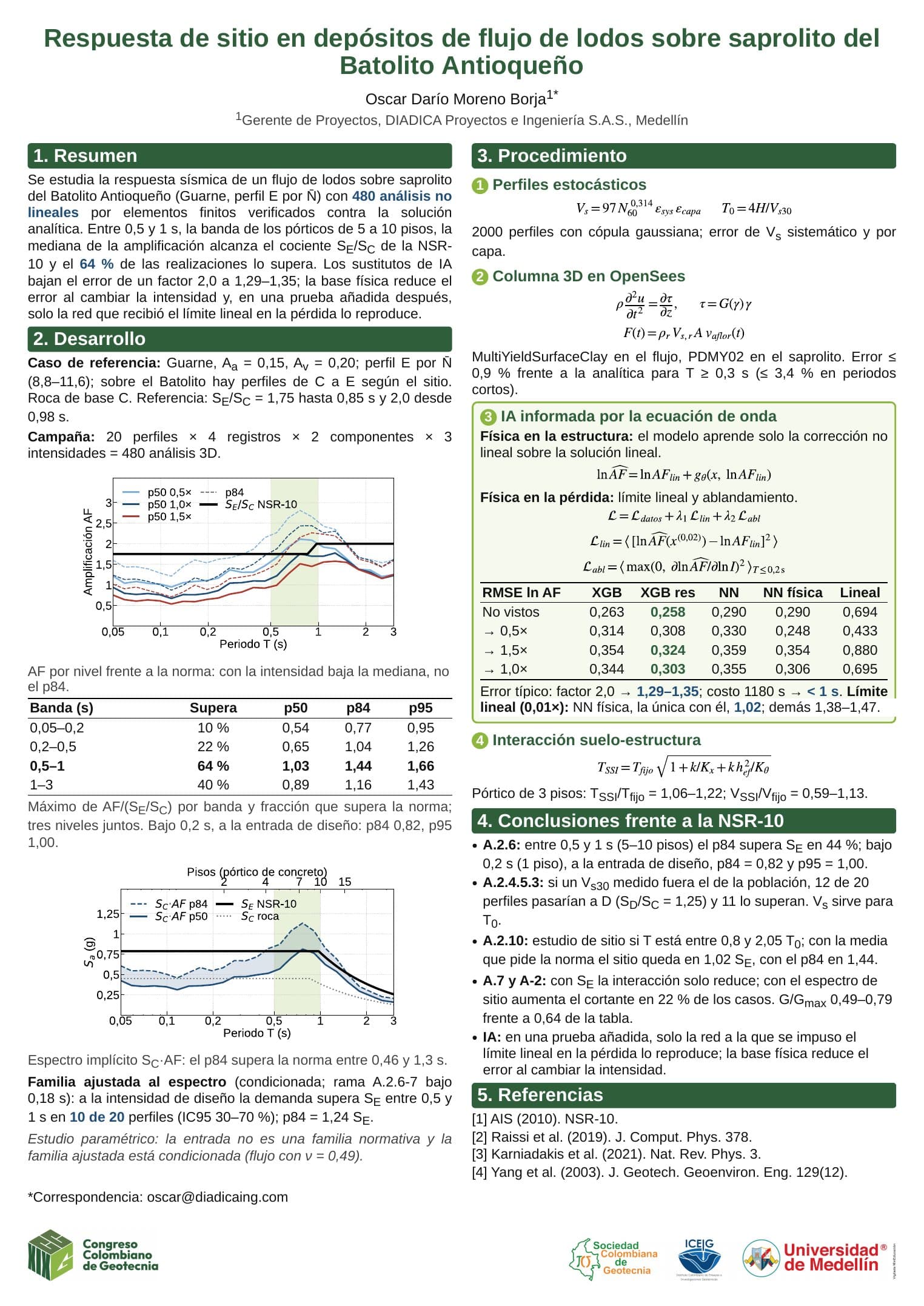 Download the poster (PDF, A0)
Project Details
- Type
- Conference paper
- Event
- XIX Colombian Geotechnical Congress (XIX CCG)
- Dates
- Medellín, October 28–30, 2026
- Status
- Accepted by the committee · not presented
- Version
- Working paper revised after evaluation, 19 pp.
- Focus Area
- Nonlinear site response and AI surrogates
- Methods
- OpenSees · stochastic profiles · surrogates