Computational Engine
The Synthetic Core
High-fidelity computational mechanics for structural systems under uncertainty.
1. Overview
Computational Engine
The Synthetic Core is the computational engine of the MAS Ecosystem.
It enables high-fidelity simulation of structural behavior under uncertainty, integrating physics-based models with controlled computational execution.
The system is designed to evaluate structural behavior as a coupled system response, not as isolated results.
All computations are traceable and based on explicit formulations, ensuring transparency in every stage of the analysis.
2. Decision Framework
Decision-grade scientific systems designed to operate under uncertainty.
The Synthetic Core operates on a quantitative decision framework that enables structured, traceable and risk-aware outcomes in complex engineering environments.
Instead of relying on purely predictive approaches, the system integrates nonlinear modeling, uncertainty handling and validation logic to support reliable decision-making across projects of different scales.
Nonlinear Modeling
Representation of complex systems beyond linear assumptions.
Uncertainty Handling
Integration of deterministic and probabilistic approaches.
Sensitivity & Interaction
Identification of key variables and nonlinear dependencies.
Traceability
Transparent linkage from inputs to final decisions.
Risk-Aware Optimization
Decisions based on quantified system behavior and risk.
Decision Consistency
Structured validation ensuring stable and auditable outcomes.
Designed following high-assurance engineering principles used in critical systems, adaptable across different levels of project complexity.
3. Computational Framework
Computational Framework
Structural Optimization
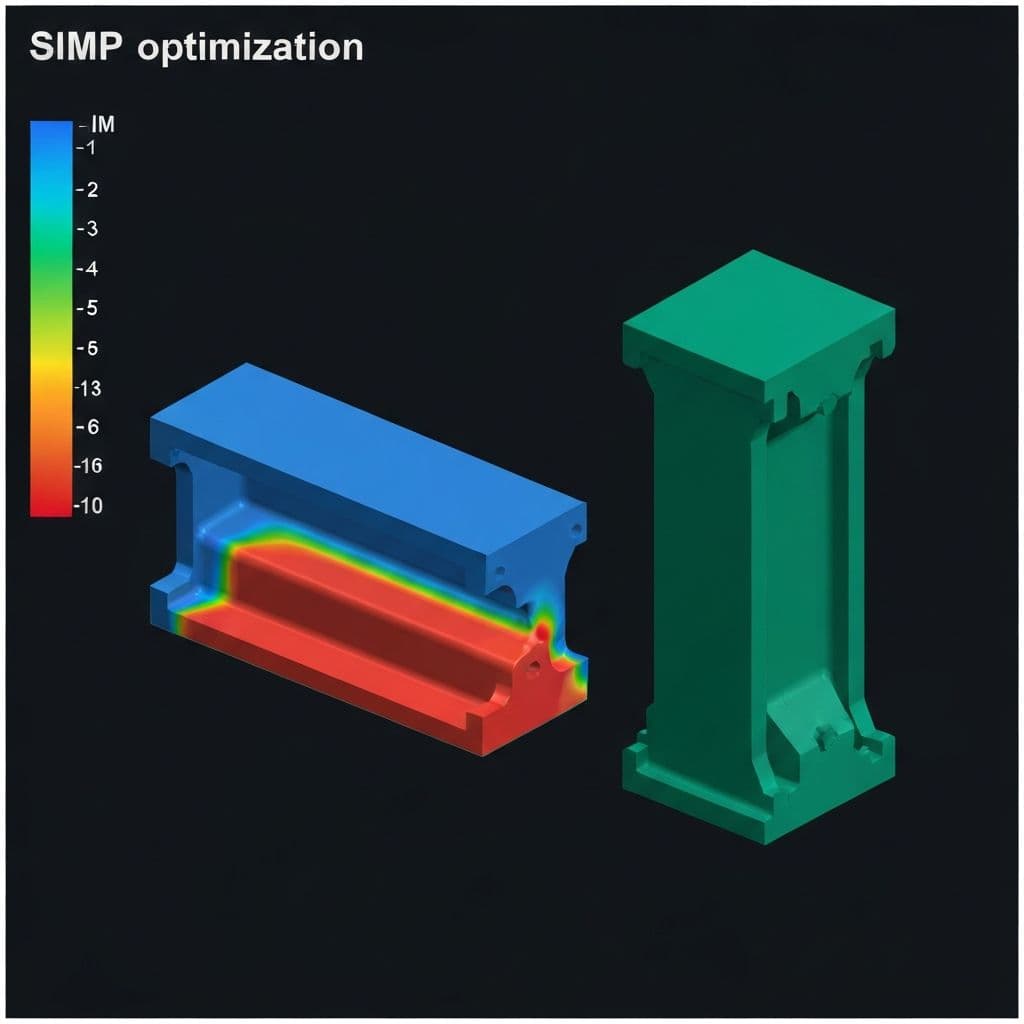
Topology Optimization (SIMP)
Topology Optimization (SIMP) is used to evaluate material distribution under structural constraints.
Code-Based Validation
Designs are validated against ACI 318-19, Eurocodes, and ASCE 7-22 for regulatory alignment.
Uncertainty Quantification
Reliability Index (β)
Reliability Index β is computed using probabilistic methods to quantify uncertainty in structural performance.
Performance-Based Design (PBD)
Non-linear dynamic simulations evaluate structural behavior under seismic and extreme loading conditions.
Structural Health Monitoring (SHM)
Digital Twins & SHM
Computational models integrate with sensor data via Bayesian inference for structural health monitoring.
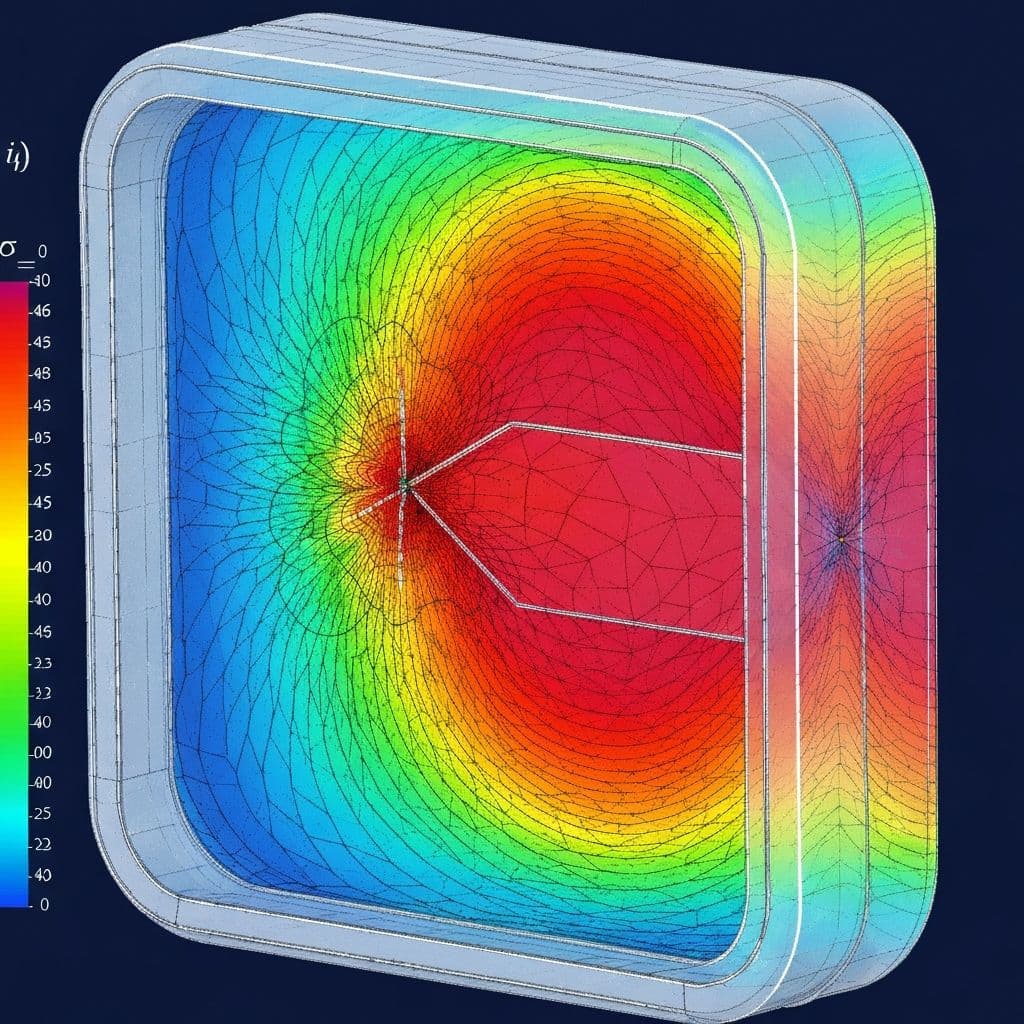
Fracture Mechanics Analysis
Fracture mechanics analysis evaluates stress distribution and crack propagation under loading conditions.
4. Computational Results
Simulation Outputs
Representative outputs from computational simulations developed within the Synthetic Core.
These outputs reflect how structural behavior is evaluated through computational models.
These results are derived from analysis, not visual approximation.
Each output corresponds to a defined computational procedure, not a visual interpretation.
Output 01
SIMP Convergence
Topology optimization output showing material distribution under structural constraints.
Output 02
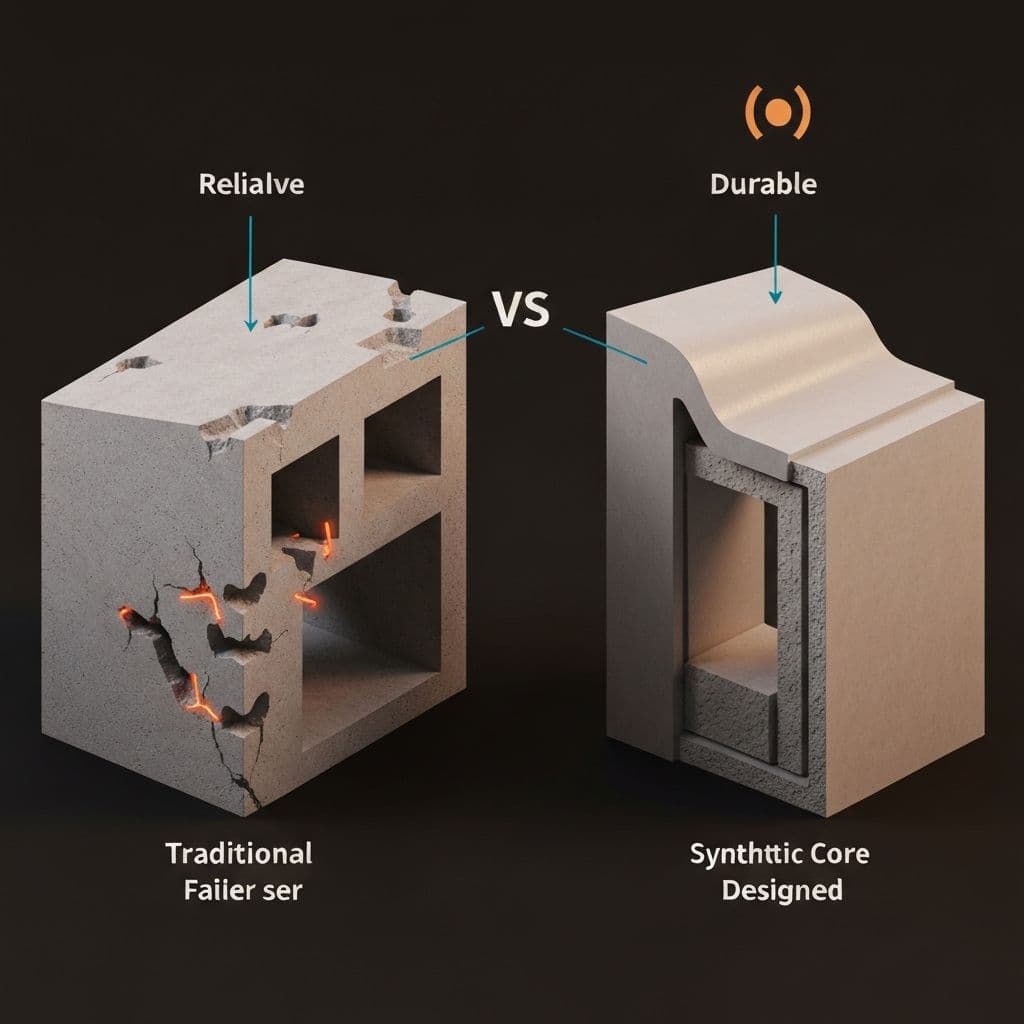
Reliability Index β (Uncertainty Quantification)
Probabilistic analysis of structural reliability, illustrating how uncertainty is quantified within the computational framework.
Output 03
Fracture Mechanics (σ_yy)
Stress field visualization at critical locations, supporting evaluation of crack propagation behavior.
5. Development Process
System Evolution
The Synthetic Core evolves through continuous research, validation, and integration within engineering workflows.
Its development follows a controlled process combining research, validation, and engineering application.
Stage 1
Applied Research
Development and validation of computational methods through research projects and applied engineering challenges.
Stage 2
Research Collaboration
Integration with academic institutions for computational research, model validation, and scientific development.
Stage 3
Engineering Integration
Application of validated computational methods within real-world engineering workflows and project delivery.
6. Application
Engineering Application
The Synthetic Core supports engineers in evaluating system behavior under complex conditions.
It is not a replacement for engineering judgment.
It is a computational extension of it.
Engineering Approach
Physics-Based Modeling
All simulations are grounded in established mechanics principles, ensuring physically consistent results.
Computational Validation
Outputs are evaluated through convergence analysis, sensitivity assessment, and comparison with analytical solutions where applicable.
Engineering Integration
Results are structured for traceability and integration into real engineering workflows.
All analyses are developed under engineering responsibility, ensuring consistency with physical principles and applicable standards.
7. Interactive Demonstration
Computational Simulations
Four independent engineering phenomena at different scales and physical behaviors.
Simulation Mode
Switch between independent analysis and system-level interaction across all simulation modules.
System Inputs
Global parameters applied to all simulation modules simultaneously.
Structural Response Simulator
Global Structural Behavior
Interactive representation of global structural response under varying system properties and external demand.
Structural Parameters
Technical Notes
- •Lateral displacement increases nonlinearly with height.
- •Shear walls provide higher stiffness, reducing drift.
- •Drift limits define performance objectives under seismic demand.
Lateral Displacement Profile
Max Drift
Stress Field
Soil-Structure Interaction Simulator
Soil Deformation & Stress Propagation
Interactive representation of soil deformation and stress distribution under foundation loading conditions.
Loading Parameters
Soil & Foundation
Soil Stress Distribution (2D)
Boussinesq-like stress propagation under foundation loading
Technical Notes
- •Stress concentration occurs directly beneath the foundation center.
- •Soft soils exhibit wider stress bulbs due to lower stiffness.
- •Dense soils concentrate stress more narrowly with faster attenuation.
- •Mat foundations distribute load more uniformly, reducing peak stress.
Dogbone Connection Simulator
Stress Concentration & Material Response
Interactive representation of stress concentration and redistribution in reduced-section steel connections.
Input Parameters
Load Intensity: 50%
Linear stress-strain relationship
Reduction: 50%
Analysis Status
Stress Distribution Field
Stress distribution under applied load in reduced section connection
Physical Interpretation
- • Stress concentration occurs at the reduced section due to lower cross-sectional area
- • As load increases, stress localizes in the center region
- • Geometry governs structural performance and failure initiation
Nonlinear Buckling Simulator
Structural Instability & Geometric Nonlinearity
Conceptual representation of nonlinear structural instability under axial loading.
Input Parameters
Response Metrics
Critical Load
60.0%
Load Ratio (P/Pcr)
0.50
Max Deflection
6.5 mm
Stability State
Stable
Physical Interpretation
- Small imperfections trigger lateral deformation under axial load.
- Increasing load leads to exponential displacement growth near critical load.
- Slender elements (high L/r) exhibit earlier instability at lower loads.
- Failure occurs due to geometric instability, not material strength.
Nonlinear instability under axial load
Engineering Interpretation: The simulation demonstrates how structural failure can occur due to instability rather than material strength, emphasizing the importance of geometric nonlinearity in design.
8. System Context
Ecosystem Integration
The Synthetic Core operates within the MAS Ecosystem as its central computational engine.
All simulations, validations, and engineering outputs are part of a structured system, not isolated processes.
9. Next Steps
Technical Discussion
Explore how computational mechanics can support your engineering challenges.
Request a technical discussion or explore the MAS Ecosystem.