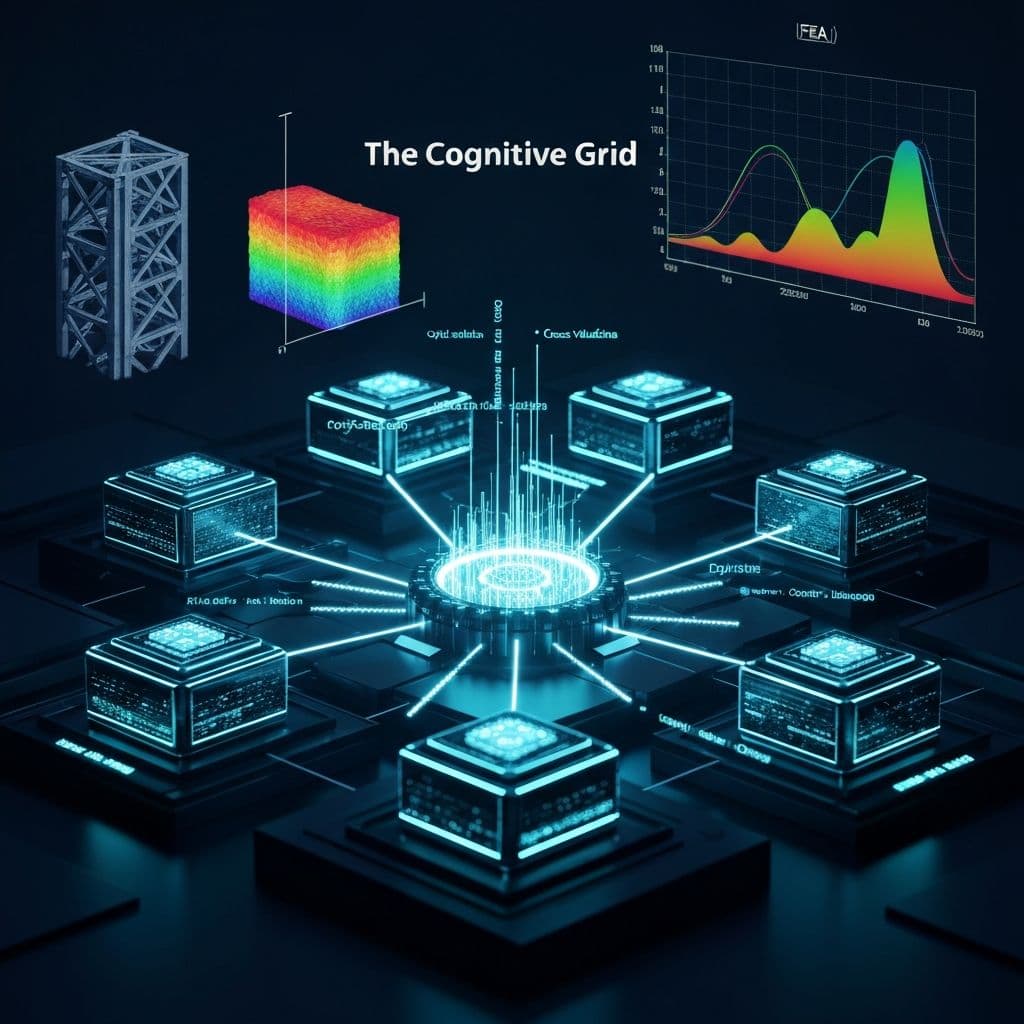
Engineering Intelligence System
The MAS Ecosystem
The MAS Ecosystem is a structured engineering intelligence system built around a central computational engine.
All engineering, simulation, and decision-support processes are organized through the Synthetic Core.
Core Framework
System Architecture
The MAS Ecosystem is organized around the Synthetic Core, which operates as its computational engine.
All engineering, simulation, and decision-support processes are structured through this central layer.
MAS does not function as independent tools, but as an integrated system.
Organizational Layers
System Structure
The system is organized into four functional layers:
Each layer interacts through a unified computational logic.
Underlying Framework
System Logic Layer
The system operates through an underlying logic layer that governs how computational processes are structured, how reasoning is executed, and how engineering decisions are organized.
This layer is not a tool, a node, or a module.
It defines the interaction between all components of the system.
Specialized Domains
Functional Layers
The MAS Ecosystem integrates multiple specialized domains within a structured system.
The system is designed to maintain clarity despite complexity, ensuring that each component operates within a defined role.
Category I
Engineering Systems
Structural Analysis & Design
Reinforced Concrete Systems
Structural analysis and design under nonlinear and seismic conditions.
Structural Steel Systems
Steel analysis, connections, and performance-based design.
Timber & Bamboo Systems
Structural design using timber and guadua under sustainable frameworks.
Masonry Systems
Confined and reinforced masonry design under seismic conditions.
Geotechnical Engineering
Soil-structure interaction and foundation systems.
Bridge Engineering
Structural analysis and design under LRFD frameworks.
Structural Pathology & Vulnerability
Damage assessment, retrofitting, and performance evaluation.
Category II
Computational Engine
The Synthetic Core
Computational Mechanics
Finite element modeling and nonlinear simulation.
Structural Optimization
Topology optimization and performance-driven analysis.
Algorithmic Finance
Quantitative systems, probabilistic modeling, and capital strategies.
Category III
Intelligence & Research
Knowledge Integration
System Orchestration
Coordination of computational processes across the ecosystem.
Computational Reasoning Architecture
Structured reasoning and system-level decision logic.
Research & Q1 Development
Scientific development, validation, and publication pipelines.
Category IV
Strategy & Governance
Decision Support
Project Management Systems
Engineering project structuring under PMI methodologies.
Business Scaling Systems
Organizational growth and strategic expansion.
Zero Black-Box
All processes within MAS are traceable, structured, and based on explicit computational logic.
Engineering outputs are not generated as opaque results, but as verifiable processes.
Structural Analysis
Structural analysis is processed through computational validation before engineering review.
Geotechnical Assessment
Geotechnical results are validated computationally and evaluated for project implications.
Optimization Process
Optimization results are verified against structural requirements and code compliance.
Computational Integration
The Synthetic Core operates as the computational engine of the MAS Ecosystem.
All simulations, validations, and engineering outputs are processed through this core before integration into decision-making layers.
Engineering Integration
Explore how the MAS Ecosystem structures engineering, computation, and decision-making into a unified system.
Or analyze the Synthetic Core as its computational engine.